
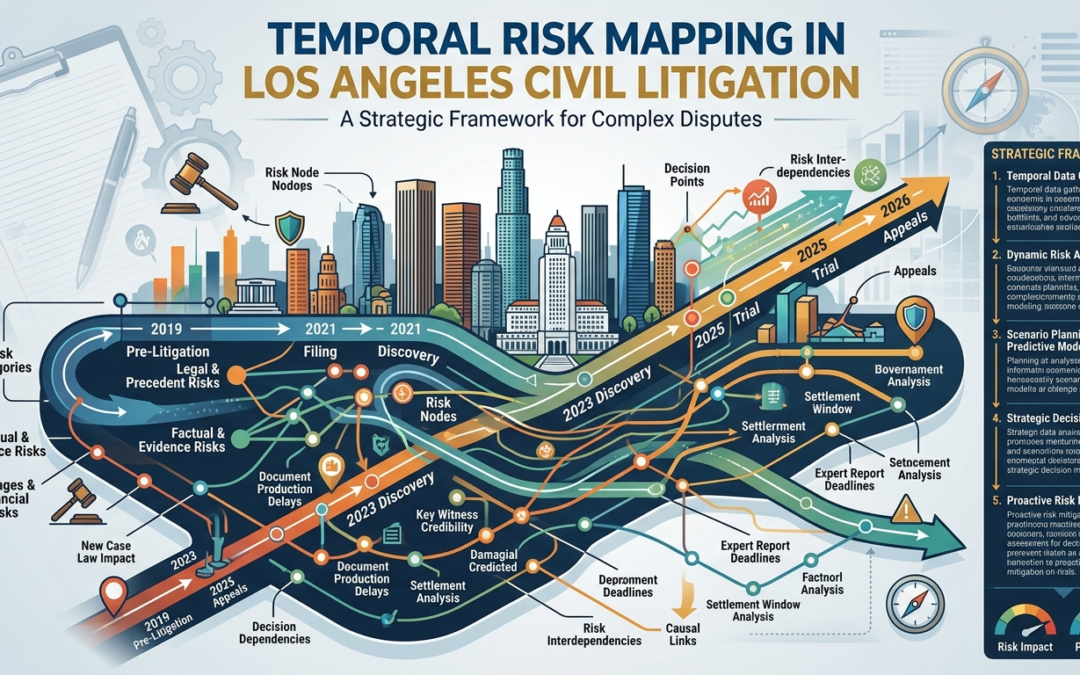
Temporal Risk Mapping in Los Angeles Civil Litigation
Civil litigation in Los Angeles has evolved into a discipline where timing, procedural precision, and strategic foresight intersect to determine outcomes. At Zand Law, we approach litigation not as a linear process but as a dynamic system shaped by deadlines, evidentiary sequencing, judicial expectations, and opposing counsel behavior. This perspective allows us to construct litigation strategies that anticipate disruption, reduce exposure, and position our clients for decisive results.
Reframing Civil Litigation as a Temporal System
Most discussions of civil litigation focus on substantive law or courtroom advocacy. While both are critical, they often overlook the temporal dimension of dispute resolution. Every case unfolds across a timeline governed by statutes of limitation, discovery schedules, motion deadlines, and trial calendars. In Los Angeles, where court congestion and procedural rigor coexist, managing this timeline is not administrative. It is strategic.
We analyze litigation as a series of interdependent time-based events. Each filing, deposition, or motion is evaluated not only for its legal merit but also for its timing impact. A well-timed motion can narrow issues before costly discovery begins. Conversely, delayed action can expand liability or weaken negotiating leverage.
Strategic Front-Loading of Case Development
One of the most effective ways to control litigation risk is through early-stage development. Rather than adopting a reactive posture, we prioritize front-loading critical elements of the case. This includes early evidence preservation, targeted legal research, and preliminary witness assessment.
In Los Angeles civil litigation, early clarity often translates into procedural advantage. Courts are more receptive to streamlined cases with clearly defined issues. By presenting a coherent narrative at the outset, we reduce the likelihood of unnecessary continuances or procedural setbacks.
This approach also strengthens settlement positioning. Opposing parties are more inclined to engage constructively when confronted with a well-prepared case that demonstrates both legal strength and procedural readiness.
Procedural Leverage Through Motion Practice
Motion practice is not merely a defensive tool. It is a mechanism for shaping the litigation landscape. Strategic motions can eliminate claims, compel disclosure, or clarify legal standards before trial.
We deploy motion practice with a focus on leverage. Each motion is evaluated for its potential to alter the trajectory of the case. In some instances, a narrowly tailored motion can significantly reduce litigation scope, saving both time and resources. In others, it can create pressure points that facilitate favorable settlement discussions.
In Los Angeles courts, where judges manage high caseloads, clarity and precision in motion practice are essential. We ensure that every submission is concise, well-supported, and aligned with judicial expectations.
Discovery as an Information Architecture Exercise
Discovery is often viewed as a burdensome phase of litigation. We treat it as an opportunity to construct an information architecture that supports our case theory. This involves designing discovery requests that extract not just data, but actionable insights.
Effective discovery in civil litigation requires more than volume. It demands relevance, sequencing, and analytical interpretation. We structure discovery to build a coherent evidentiary framework, ensuring that each piece of information contributes to a larger narrative.
In Los Angeles, where discovery disputes are common, disciplined execution reduces the risk of objections and delays. It also enhances credibility with the court, which can influence rulings on contested issues.
Managing Judicial Expectations in a High-Density Court System
Los Angeles courts operate under significant workload pressure. Judges prioritize efficiency, clarity, and adherence to procedural rules. Understanding these expectations is critical to effective litigation.
We align our litigation strategy with the operational realities of the court system. This includes adhering strictly to deadlines, presenting well-organized filings, and avoiding unnecessary procedural complications. By doing so, we position our clients as credible and prepared participants in the judicial process.
Judicial perception can influence discretionary decisions, including rulings on motions, scheduling, and evidentiary matters. A disciplined approach to court engagement enhances the likelihood of favorable outcomes.
Settlement Dynamics and Strategic Positioning
Not all civil litigation proceeds to trial. In fact, many cases resolve through settlement. However, successful settlement is not a matter of compromise alone. It is the result of strategic positioning.
We approach settlement as a continuation of litigation strategy. Every action taken during the case contributes to our negotiating position. Strong evidence, effective motion practice, and procedural discipline all increase leverage at the negotiation table.
In Los Angeles, where litigation costs can escalate quickly, timely and well-structured settlements offer significant value. Our objective is to secure resolutions that align with our clients’ interests while minimizing unnecessary expenditure.
Trial Readiness as a Continuous State
Even when settlement is likely, trial readiness must be maintained. Courts expect parties to be prepared, and last-minute adjustments can undermine credibility. We treat trial preparation as an ongoing process rather than a final phase.
This includes continuous refinement of legal arguments, witness preparation, and evidentiary organization. By maintaining a state of readiness, we ensure that our clients are not disadvantaged by sudden procedural developments or shifts in case dynamics.
Trial readiness also reinforces settlement leverage. Opposing parties are more inclined to negotiate when they recognize that we are fully prepared to proceed to trial if necessary.
Risk Mitigation Through Predictive Analysis
Modern civil litigation increasingly benefits from predictive analysis. By examining patterns in case law, judicial behavior, and opposing counsel strategies, we can anticipate potential challenges and opportunities.
At Zand Law, we integrate analytical tools with legal expertise to forecast litigation outcomes. This allows us to identify high-risk areas early and implement mitigation strategies. Whether addressing potential evidentiary gaps or anticipating procedural objections, proactive analysis reduces uncertainty.
Civil litigation in Los Angeles demands more than legal knowledge. It requires a structured, time-sensitive, and strategically integrated approach. By viewing litigation as a temporal system and emphasizing early development, procedural leverage, and continuous readiness, we deliver outcomes that reflect both precision and foresight.
At Zand Law, we are committed to advancing our clients’ interests through disciplined strategy and rigorous execution. Each case is approached as a complex system requiring careful orchestration. Through this methodology, we navigate the intricacies of Los Angeles civil litigation with clarity and purpose.